
Issue, September 2026
Newsletter
August's Most-Watched Sessions - You Can't Afford to Miss These
This month, here are the major highlights from August – because good learning shouldn’t feel like extra work. Our goal is simple: make your residency journey a little easier, and keep your knowledge a little more upgraded, one session at a time.
From a labour-mechanics that finally makes deep transverse arrest click, to a ward-round-ready refresher on puerperal sepsis, to a timely walk-through of the new RCOG 2026 guideline on placenta previa and PAS – here’s everything that happened last month, and why it’s worth your revision time.
Major Highlight of the Month
1. Deep Transverse Arrest, explained from first principles by Dr. Raina Chawla
What DTA actually is
Deep transverse arrest is what happens when the fetal head gets stuck with the sagittal suture sitting in the transverse diameter of the pelvis – hence “transverse” – at the level of the ischial spines, where the levator ani and pelvic floor sit. Because this is where the problem occurs, the head is typically arrested at station zero, which is where “deep” comes from.
Where it fits in the mechanism of labour
DTA is one possible outcome of an occipitoposterior (OP) position. From an OP starting point, four things can happen: long arc rotation (~90%, the head turns a full 135° and effectively becomes OA), short arc rotation (~5%, a 45° “shortcut” ending in face-to-pubis delivery), deep transverse arrest (~5%, rotation stalls transverse at the ischial spines despite good contractions and full dilatation), and persistent OP (~1–2%, nothing rotates at all).
Why occipitoposterior happens
The strongest association is the anthropoid pelvis, with the android pelvis a lesser but important contributor – and android is actually the pelvis most specifically tied to DTA, since its prominent ischial spines and narrow bispinous diameter physically trap the head at zero station. A macrosomic fetus, an anterior placenta, and a lax abdominal wall (common in multigravida) round out the risk factors.
Spotting it clinically
Look for sub umbilical flattening on abdominal inspection, and in labour, watch for a premature urge to bear down, incomplete bladder emptying, early rupture of membranes, and an overall prolonged labour.
KEY HIGHLIGHT: A concept-first walk-through that turns DTA from a memorised short note into something you can actually reason through in the exam hall or the labour room — grounded in JB Sharma, Mudaliar & Menon, and the RCOG/TOG article on managing malposition in second stage.
Watch the Full DTA Session
2. COBG Long video Leiomyosarcoma and other Uterine Tumors by Dr. Tejas Gopalkrishnan
What you’ll learn:
- The definition of puerperium, and ACOG’s “fourth trimester” framing
- Diagnostic criteria for puerperal pyrexia
- Causes of fever in the puerperium, led by metritis
- Maternal and delivery-related risk factors, including why caesarean section carries ~25x the risk
- The gram-positive, gram-negative, and anaerobic organisms behind postpartum infection
Key highlight: A ward-round-ready session that connects the textbook definition of puerperal pyrexia to the actual organisms and risk factors you’ll be screening for at the bedside.
3. RCOG 2026: Placenta Previa & Placenta Accreta Spectrum Explained by Dr. Raina Chawla
What you’ll learn:
- The latest RCOG 2026 definitions for placenta previa and PAS
- Updated risk factors and diagnostic approach
- Recommended follow-up for suspected PAS
- How the guideline translates into clinical decision-making
Key highlight: A timely guideline breakdown built with MRCOG, NEET PG/SS, and MS/DNB exam relevance front and centre, so you’re studying from what’s current rather than what’s outdated.
AUGUST AT A GLANCE
This month’s highlights
✓ Deep transverse arrest broken down from mechanism to management
✓ A complete refresher on puerperal pyrexia and sepsis
✓ The new RCOG 2026 guideline on placenta previa and PAS, explained
✓ Continuous content updates across the Conceptual OBG platform
And this is just a glimpse of what’s on the platform. New lectures, guideline updates, and case discussions are added every week to keep your revision current.
GO FURTHER
Unlock the Complete Conceptual OBG Experience
With Conceptual OBG Premium, you get access to everything, in one place:
- Complete lecture series by legendary faculty
- High-yield clinical discussions
- Guideline updates as they’re released
- Practical demonstrations
- Exam-oriented learning resources
- Learn anytime, anywhere
Whether you’re preparing for MS/DNB, NEET SS, or INI-CET SS, or simply strengthening your clinical knowledge, Conceptual OBG brings it all together on one platform.
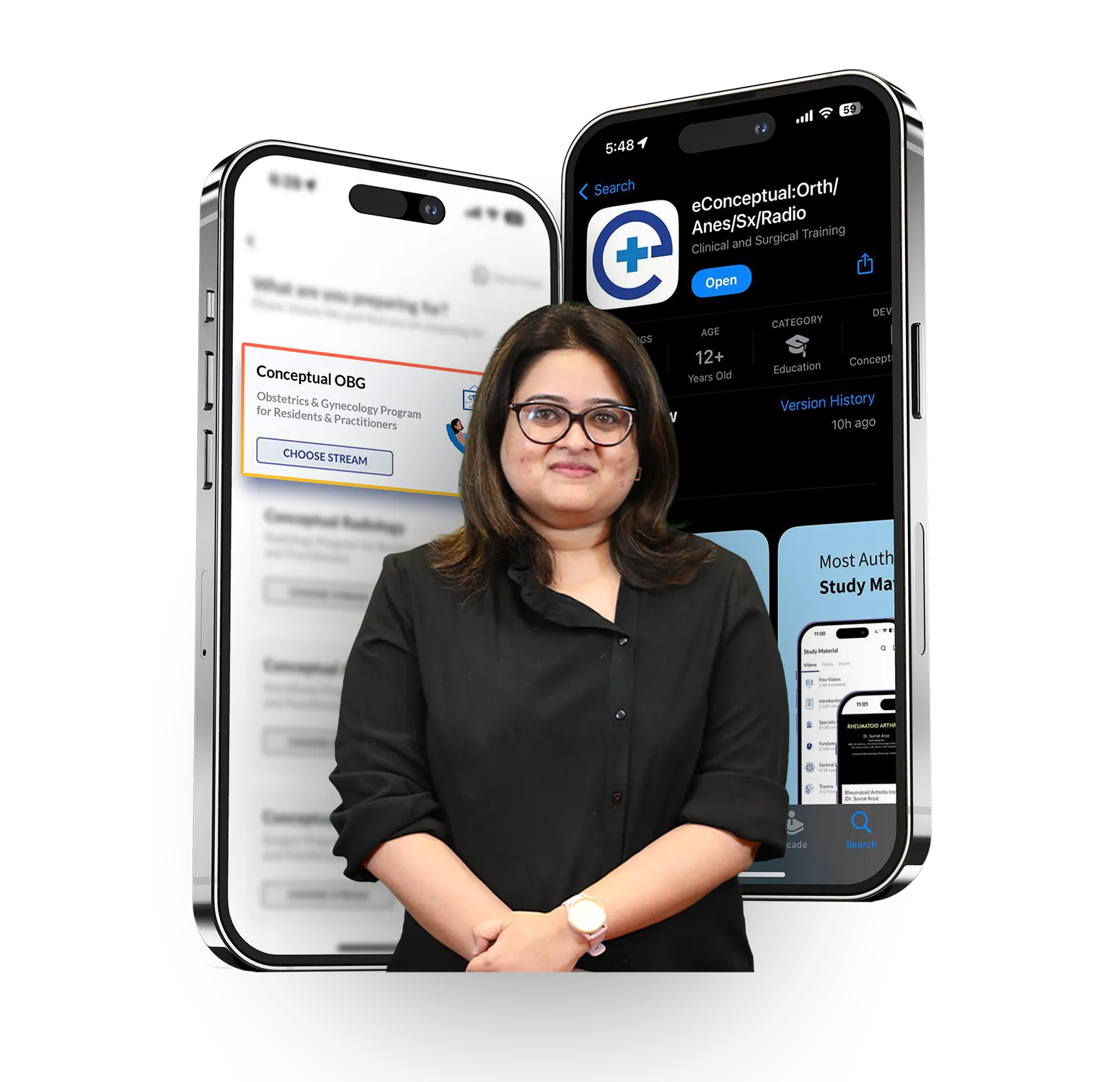
👉 Download the eConceptual app and subscribe Conceptual OBG!!
Start your journey with Conceptual OBG and learn from India’s leading OBG faculty – anytime, anywhere.