
DNB vs MS Obstetrics d copy

DNB vs MS Obstetrics & Gynecology: What Should You Choose? | Part 1 

0
0

Estimated reading time: 6 minutes

NEET PG 2026 is finally over, and now you are waiting for the result. 

You may have already started thinking about the branches you could choose. Maybe Obstetrics & Gynaecology (OBG) is on your list. 

You like the idea of managing pregnancies, handling emergencies, assisting in deliveries, performing surgeries and being involved in both medical and surgical care. 

But then another question comes up: 

“Should I choose MS Obstetrics & Gynaecology or DNB Obstetrics and Gynaecology?” 

And once you start asking around, you hear everything. 

  • “MS is better.” 
  • “DNB gives more clinical exposure.” 
  • “Look at the hospital, not the degree.” 
  • “DNB exams are difficult.” 
  • “MS is better for academics.” 

Confused already? 

Let’s simplify it. 

This two-part guide will help you understand MS Obstetrics & Gynaecology and DNB Obstetrics and Gynaecology, what residency can look like, how to compare institutes and what you should actually consider before making your NEET PG 2026 choice. 

In Part 1, let’s focus on the training and residency experience. 

1. What Is MS Obstetrics & Gynecology? 

MS stands for Master of Surgery. 

MS in Obstetrics & Gynecology is a postgraduate medical degree in the specialty of Obstetrics and Gynaecology. 

And OBG is much more than just deliveries and Caesarean sections. 

During residency, you may be exposed to: 

  • Antenatal and postnatal care 
  • Normal and high-risk pregnancies 
  • Labour room management 
  • Caesarean sections 
  • Obstetric emergencies 
  • Postpartum haemorrhage 
  • Pre-eclampsia and eclampsia 
  • Ectopic pregnancy 
  • Gynaecology OPD 
  • Gynaecology OT 
  • Laparoscopy and hysteroscopy 
  • Infertility-related cases 
  • Ultrasound and other investigations 

The exact exposure, however, depends greatly on the institute. 

A hospital may have all these services, but that doesn’t automatically mean every resident gets the same hands-on experience. 

And that brings us to DNB. 

2. What Is DNB Obstetrics and Gynecology? 

DNB stands for Diplomate of National Board. 

DNB in Obstetrics and Gynecology is a postgraduate training programme conducted through NBEMS-accredited institutions. 

Like MS, DNB OBG involves: 

  • Clinical training 
  • Academic teaching 
  • Practical experience 
  • Research 
  • Thesis/dissertation work 
  • Examinations and assessments 

Depending on the institute, DNB residents may get exposure to labour room, high-risk obstetrics, Caesarean sections, gynecology OPD, gynecology OT, emergencies, ultrasound and various procedures. 

3. MS OBG vs DNB OBG: What Is the Basic Difference? 

Both are postgraduate pathways in Obstetrics and Gynaecology, but they come under different training frameworks. 

Details MS Obstetrics & Gynaecology DNB Obstetrics and Gynaecology 
Full form Master of Surgery in Obstetrics & Gynaecology Diplomate of National Board in Obstetrics and Gynaecology 
Training framework Medical college/university system NBEMS system 
Duration Generally 3 years after MBBS Generally 3 years for post-MBBS broad-specialty DNB 
Training Clinical + academic + practical Clinical + academic + practical 
Assessment Applicable university/NMC framework NBEMS framework 

So, are MS and DNB completely different specialties? 

No. 

Both are postgraduate training pathways in OBG. 

But an MS OBG seat at one institute and a DNB OBG seat at another can provide very different residency experiences. 

That is why simply comparing the degree names may not be enough. 

4. What About Clinical Exposure in MS vs DNB OBG? 

This is probably one of the biggest questions during counselling: 

“Does DNB OBG have better clinical exposure than MS OBG?” 

You may hear a quick yes or no. 

But the reality is more specific. 

Clinical exposure depends heavily on the institute, patient volume, faculty, number of residents and how much responsibility residents receive. 

For OBG, look at things such as: 

Labour Room 

How many deliveries take place? 

How is the workload divided among residents? 

Do residents get meaningful hands-on experience? 

OT 

How frequently do residents get OT exposure? 

What role do residents play in Caesarean sections and gynaecological surgeries? 

Emergency 

How much exposure is there to obstetric and gynaecological emergencies? 

Gynaecology 

What is the OPD volume? 

How much exposure is there to common and complex gynaecological conditions? 

Procedures 

Is there exposure to ultrasound, laparoscopy, hysteroscopy and other relevant procedures? 

So instead of asking: 

“Is DNB better for exposure?” 

ask: 

“What exposure will I get in this specific DNB seat compared with this specific MS seat?” 

That is a much more useful question. 

5. What Should You Check Before Choosing an OBG Seat? 

Before putting an institute on your NEET PG 2026 preference list, try to speak to current residents or recent pass-outs. 

Don’t just ask: 

“Is this college good?” 

Ask specific questions. 

  • Patient load: 
    How busy is the OBG department? 
  • Deliveries: 
    How many deliveries does a resident typically see? 
  • Caesarean sections: 
    How much operative exposure do residents get? 
  • Labour room: 
    How are duties divided? 
  • OT: 
    Do residents get hands-on opportunities? 
  • Emergency: 
    How frequent are night and emergency duties? 
  • Academics: 
    Are seminars, case discussions and viva preparation regular? 
  • Faculty: 
    How involved are consultants in teaching? 
  • Workload: 
    How many residents share the clinical workload? 

These answers can tell you much more than simply hearing that an institute has a “good OBG department.” 

6. MS or DNB OBG: What Should You Actually Compare? 

Imagine you have two options after NEET PG 2026: 

MS Obstetrics & Gynecology — Institute A 

versus 

DNB Obstetrics and Gynecology — Institute B 

Don’t immediately compare only MS vs DNB. 

Compare the actual residency experience: 

Patient volume 

↓ 

Delivery exposure 

↓ 

Labour room experience 

↓ 

OT and surgical exposure 

↓ 

Emergency workload 

↓ 

Hands-on opportunities 

↓ 

Academics and faculty 

↓ 

Resident workload 

This will give you a clearer picture of what your three years may actually look like. 

So, which one should you choose? 

There isn’t a simple “MS is better” or “DNB is better” answer that applies to every institute. 

Your comparison should be between the specific seats available to you, the training environment, clinical exposure and your future plans. 

And there is still another important part of the question: 

What happens after residency? 

What about career options, salary, senior residency, teaching, private practice, government jobs, fellowships and further specialisation? 

We’ll cover these questions in Part 2 of DNB vs MS Obstetrics & Gynaecology after NEET PG 2026. 

Read Part 2 before finalizing your OBG choices during counseling. 

Share

WhatsApp Image 2026-09-05 at 5.59

DNB OBG Practicals Are Next: Time to Turn Preparation into Confidence 

0
0

Estimated reading time: 3 minutes

The theory papers are finally over. The result is out. And after months of preparation, you finally have a moment to breathe. 

Congratulations to all DNB OBG residents who cleared their theory examination!  

At Conceptual OBG, it is an even bigger moment of celebration. So many of our residents have achieved excellent scores, making the entire team proud of their hard work and dedication. 

But now, it’s time to look ahead. 

The practical examination is next. 

And this phase needs a different approach. 

You Know the Theory. Can You Apply It? 

In the practical exam, you won’t simply be asked to recall what you studied. 

You may be asked to present a case, demonstrate an examination, identify an instrument, interpret an image or handle a viva that takes you from one clinical question to another. 

The real question is: 

Can you explain what you know when the examiner is sitting right in front of you? 

That confidence comes from practice, not just revision. 

What Should You Focus on Now? 

Case Presentations 

Practice presenting obstetric and gynecological cases in a clear and structured manner. Work on your history, examination, diagnosis, differentials and management. 

Clinical Examination 

Don’t just revise examination steps. Perform them. Repeated practice will make your approach much more natural during the examination. 

Instruments & Images 

Revise important instruments, scans, clinical images, and other practical components. Train yourself to identify and explain them quickly. 

Viva 

Prepare beyond one-line answers. Think about the next question the examiner could ask and practice explaining your reasoning confidently. 

Want to See How Our Residents Performed? 

Our DNB OBG achievers have given us plenty to celebrate. If you haven’t checked the results yet, you can take a look here: 

Check the DNB OBG Results 

The results are a proud milestone, but the journey isn’t over yet. 

Now the practical examination is the goal. 

Need Help With Your Practical Preparation? 

If you feel you need additional guidance or a more structured way to prepare, Conceptual OBG can be a part of your preparation journey. 

Use the platform to strengthen your concepts, improve your clinical understanding and revise the areas that matter during your residency and examinations. 

The goal isn’t just to remember an answer. 

It’s to understand the case well enough to explain it. 

So if you’re still thinking, “I’ll start practical preparation in a few days,” don’t wait. 

Start now. 

Theory Is Over. Your Practical Journey Starts Now. 

Celebrate your result. Be proud of your achievement. 

Then get back to preparation. 

Present cases. Practise examinations. Revise images. Prepare for viva. 

And when you walk into that practical examination, make sure your preparation speaks for you. 

Theory cleared. Practicals next. Now, make it count.

Share

DNB OBG Practical Exam

DNB OBG Practical Exam: Common Mistakes and How to Avoid Them

0
0

Estimated reading time: 6 minutes

In the DNB OBG Practical Exam, the examiner is not only checking what you know. They are watching how you approach a patient, how you examine, how you present a case, how you interpret findings, and how confidently you handle the next question. 

For many DNB OBG residents, this is where small mistakes can make a big difference. 

The good news? Most of these mistakes are avoidable. 

What Makes the DNB OBG Practical Exam Different? 

During residency, you may perform a procedure or examine a patient dozens of times. But an examination situation is different. You have limited time, an examiner observing you, and a case that may not behave exactly like the textbook. 

The aim is not to sound like you have memorised an answer. 

The aim is to demonstrate clinical thinking. 

That means your preparation should go beyond reading notes. You need to practise case presentation, examination, viva questions, instruments, images, procedures and clinical decision-making. 

1. Preparing Only for Theory 

This is probably one of the most common mistakes. 

After the DNB theory examination, many residents start preparing for practicals almost from scratch. By then, there is very little time to build confidence. 

Your theory preparation should actually support your practical preparation. 

For example, if you are revising PPH, don’t stop at definitions and management protocols. Ask yourself: 

  • How would I assess this patient at the bedside? 
  • What would I look for on examination? 
  • How would I present the case? 
  • What are the causes? 
  • What would I do first? 
  • When would I escalate management? 

That shift from “What is the answer?” to “What would I do?” is extremely important for DNB practical preparation. 

2. Not Practising Case Presentation 

Knowing a case and presenting a case are two different skills. 

You may know every detail, but if your presentation is disorganised, the examiner may struggle to understand your clinical approach. 

Practise presenting common OBG cases in a fixed, logical order. 

For example: 

Patient → Complaints → Relevant history → Examination → Investigations → Diagnosis → Differentials → Management 

Don’t try to make every presentation sound fancy. 

Make it clear, structured and clinically relevant. 

A simple presentation delivered confidently is far better than a long presentation where important points get buried. 

3. Missing Basic Examination Steps 

Under pressure, residents sometimes rush through examination. 

And that is exactly when basic steps get missed. 

Before every examination, remind yourself: 

Explain → Consent → Position → Examine systematically → Thank the patient → Present findings 

Don’t assume that the examiner will overlook a missed step because you know the rest of the case. 

In practical examinations, your approach itself is being assessed. 

4. Giving an Answer Without Thinking It Through 

A viva can quickly move from a straightforward question to a clinical situation. 

For example: 

“This patient has postpartum haemorrhage. What will you do?” 

Don’t immediately start reciting every possible treatment. 

Think. 

Is the patient stable? 
What is the likely cause? 
What should I do immediately? 
What comes next if the first step fails? 

Examiners often want to see whether you can prioritise. 

So before answering, take a second. 

Think → Prioritise → Answer. 

That small pause can make your response much more confident. 

5. Ignoring Instruments, Images and Specimens 

DNB OBG practical preparation is not limited to long cases. 

You should be comfortable identifying and discussing: 

  • Instruments 
  • Obstetric and gynaecological specimens 
  • Ultrasound images 
  • CTG traces 
  • X-rays and other relevant imaging 
  • Histopathology images 
  • Common clinical photographs 
  • Contraceptive devices 

Don’t just memorise the name. 

For every instrument, ask: 

What is it? 
What is it used for? 
How is it used? 
What are its important precautions or complications? 

That is much closer to the way viva questions actually develop. 

6. Not Revising Common Procedures 

You don’t necessarily need to memorise every procedure word-for-word. 

But you should know the indications, basic steps, complications and important precautions of procedures relevant to your training. 

Practice explaining procedures aloud. 

If you cannot explain a procedure without looking at your notes, you probably haven’t revised it enough for a practical examination. 

7. Panicking When You Don’t Know the Answer 

This happens to almost everyone. 

You get a question you haven’t prepared for, and suddenly the next three answers also disappear from your mind. 

Don’t let one question affect the rest of the viva. 

If you don’t know something, don’t start guessing wildly. 

You can say: 

“I am not completely sure about this, sir/ma’am.” 

Then use your clinical reasoning where possible. 

The practical exam is not about proving that you know everything. 

It is about showing that you can think safely and clinically. 

8. Studying Everything but Revising Nothing 

The last few days before the practical examination are not the time to start collecting more and more material. 

At this stage, revision matters more than accumulation. 

Focus on: 

Common cases + Common procedures + Instruments + Images + Viva questions + Emergency scenarios 

And revise them repeatedly. 

The goal is to make important information easy to retrieve under pressure. 

A Simple DNB OBG Practical Preparation Strategy 

If your practical examination is approaching, divide your preparation into five areas: 

1. Cases 

Practise presenting common obstetric and gynaecological cases. 

2. Viva 

Ask yourself questions aloud instead of silently reading answers. 

3. Procedures 

Revise indications, steps, complications and clinical decision-making. 

4. Spotters 

Practise instruments, images, specimens and clinical findings. 

5. Mock Practicals 

Get someone to actually examine you. 

Because there is a big difference between “I know this” and “I can answer this when someone is standing in front of me.” 

Where Conceptual OBG Can Help?

DNB practical preparation becomes much easier when your preparation is organised around clinical understanding rather than scattered revision. 

Conceptual OBG focuses on helping OBG residents strengthen their concepts and approach clinical situations with greater clarity. 

Use your preparation time to connect theory with bedside application—because that is exactly what the practical examination demands. 

Don’t wait until the last few days to discover where you are weak. 

Practise now. Present cases now. Take mock vivas now. 

The practical exam is not the time to learn how to perform. 

It is the time to demonstrate that you can. 

Final Takeaway 

You don’t need to know every possible question to perform well in your DNB OBG Practical Exam. 

You need to be systematic. 

You need to think clinically. 

And most importantly, you need to practise answering and presenting—not just reading. 

Your theory result may get you to the practical examination. 

Your clinical approach is what helps you get through it. 

Share

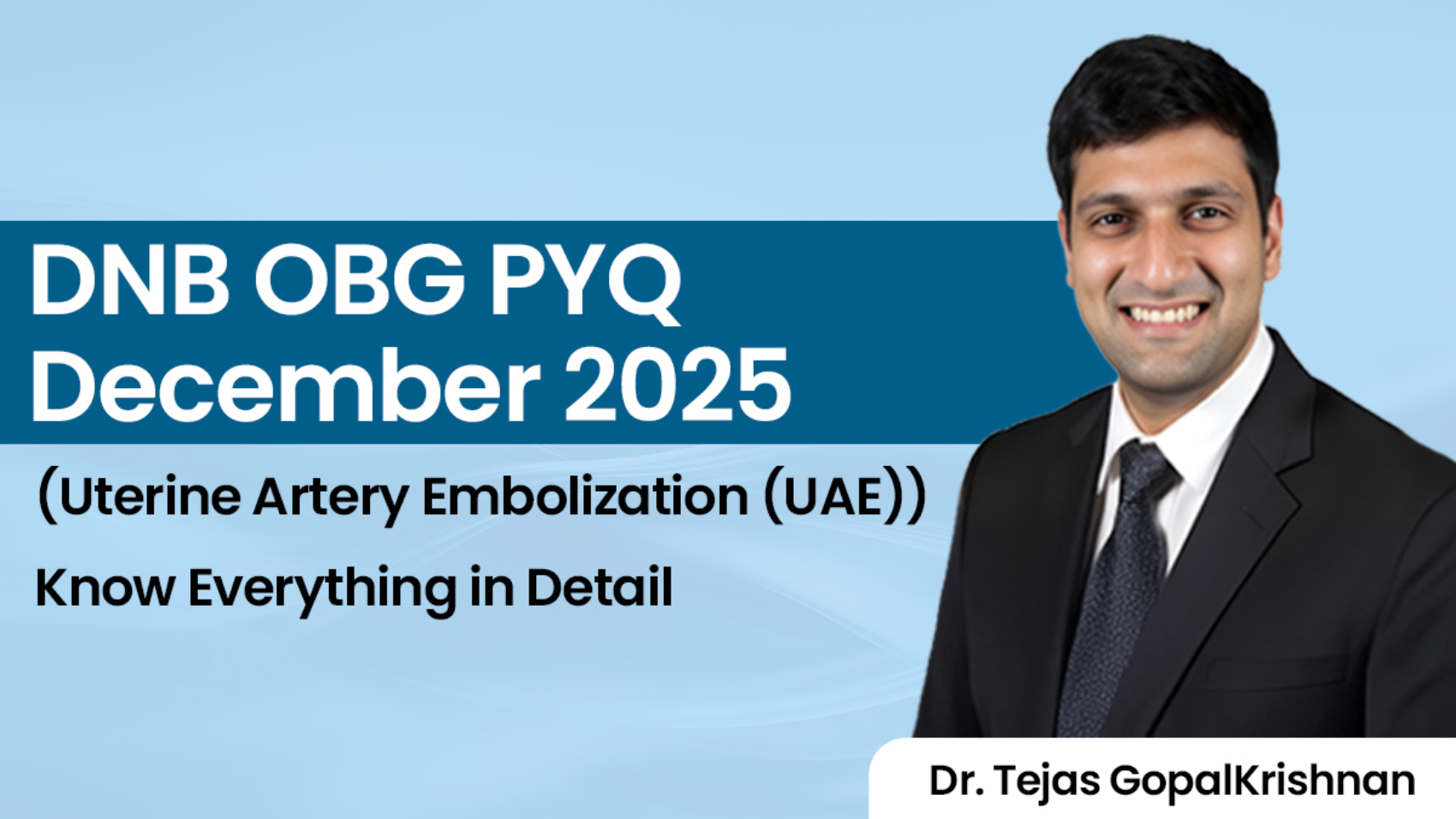
Dr. Tejas GopalKrishnan

DNB OBG PYQ December 2025 (Uterine Artery Embolization(UAE)– Know Everything in Detail 

0
0

Estimated reading time: 4 minutes

Dear residents, If you appeared for the DNB December 2025 OBG exam, this question probably caught your attention, right? 
“Discuss the indications, procedure, and complications of Uterine Artery Embolization (UAE).” 

Here, Dr. Tejas GopalKrishnan highlighted why this question is so important. According to him, there isn’t much left to ask beyond these three areas—indications, procedure, and complications. That makes this a topic every DNB aspirant should be comfortable with. 

UAE Is Not Just About Fibroids 

Most of us study uterine artery embolization while reading fibroids and often stop there. But that’s exactly where many students lose marks in exams. 

UAE has both obstetric and gynecological applications. 

Obstetric Indications 

One of the most important indications is Placenta Accreta Spectrum (PAS). With rising cesarean section rates, PAS has become a frequently discussed topic in examinations as well as clinical practice. 

Another indication is postpartum hemorrhage (PPH). Although UAE is not usually the first option in an actively bleeding unstable patient, it remains a recognized option in selected stable cases. 

Cervical ectopic pregnancy is another situation where UAE can be extremely useful. Since the cervix lacks a strong contractile mechanism, surgical intervention can result in significant bleeding. Embolizing the uterine arteries beforehand helps reduce blood loss and makes management safer. 

Gynecological Indications 

The most commonly remembered indication is, of course, uterine fibroids. 

Other important indications include: 

  • Adenomyosis  
  • Uterine arteriovenous malformations (AVMs)  
  • Advanced gynecological malignancies where bleeding control is required  

A common mistake students make is mentioning only fibroids. In a 10-mark question, that answer remains incomplete. 

How Is UAE Performed? 

The procedure is usually carried out by an interventional radiologist. 

The catheter is introduced through the femoral artery and guided towards the internal iliac artery. From there, the uterine arteries are identified and embolized. 

An important point for exams is that both uterine arteries are embolized. 

Why? 

Because if only one side is embolized, collateral circulation can continue supplying the pathology, reducing the effectiveness of the procedure. 

After embolization, angiography is repeated to confirm successful blockage of blood flow before removing the catheter. 

Complications You Should Never Forget 

A complete answer is impossible without discussing complications. 

The most commonly discussed immediate complication is post-embolization syndrome, which presents with: 

  • Fever  
  • Pain  
  • Nausea  
  • Malaise  

This happens because ischemic tissue releases inflammatory mediators and cytokines. 

Other immediate complications include: 

  • Hematoma at the puncture site  
  • Pelvic pain and cramping  
  • Pseudoaneurysm formation  
  • Arterial dissection  
  • Non-target embolization  

One particularly important complication is accidental embolization of the ovarian artery, which may result in ovarian dysfunction and even premature ovarian insufficiency. 

What About Fertility? 

This is often the final point examiners expect. 

Uterine artery embolization is generally avoided in women who still plan to conceive. 

Studies have linked UAE with: 

  • Increased miscarriage rates  
  • Higher risk of preterm birth  
  • Abnormal placentation  
  • Reduced fertility potential  

That is why it is usually not the preferred option in younger women with fibroids who have not completed their families. 

DNB Exam Takeaway 

This was one of the highest-yield questions from the DNB December 2025 OBG paper. If you had covered UAE thoroughly, this question offered a great opportunity to score. 

For exam writing, remember a simple formula: 

Indications → Procedure → Complications → Fertility Concerns 

Follow this structure, add a simple diagram, and your answer becomes much more scoring. 

Want More DNB OBG PYQs Like This? 

At Conceptual OBG, we don’t just discuss answers, we discuss the logic behind them and the similar types of question and what can be possible questions from that topic. From DNB PYQs and expected questions to high-yield concepts that repeatedly appear in exams, the focus is on helping you understand what really matters in the DNB Exam. 

If you’re serious about DNB OBG preparation and don’t want to miss important topics, subscribe to Conceptual OBG and get access to discussions that can genuinely make a difference in your exam performance. 

Watch Video: Dec DNB 2025 OBG Question Discussion with Dr. Tejas GopalKrishnan | Conceptual OBG | DNB Exam

Share

DNB Final OBG

DNB Final OBG Exam in 30 Days: A Realistic Last-Month Plan for OBG Residents 

0
0

Estimated reading time: 6 minutes

The last month before the DNB Final OBG exam should focus on revision, case presentation, practical approach, viva confidence, and high-yield obstetrics and gynecology topics. Instead of trying to complete every textbook again, residents should focus on concepts, protocols, emergencies, and repeated revision. 

Introduction: 

Every OBG resident knows how hectic the final month before DNB Finals can become. 

There are labour room duties, emergency calls, OT work, ward rounds, incomplete notes, and constant anxiety about practical’s and viva. 

Most residents feel like they still have too much left to study. 

But honestly, the last month is not about reading everything again. 

It is about: 

  • Smart revision  
  • Clinical confidence  
  • Better presentation  
  • Protocol-based management  
  • Practical preparation  
  • Staying calm during viva  

Many residents spend the final few weeks switching between notes, PDFs, apps, and random videos. That usually creates confusion instead of confidence. 

The residents who perform well are usually the ones who revise consistently, focus on high-yield topics, and practice clinical discussions regularly. 

If you are preparing for DNB Final OBG, this is a realistic last-month strategy that actually works during residency. 

What Should OBG Residents Focus on in the Last Month? 

The final month should mainly focus on commonly asked and clinically important topics. 

Obstetrics 

This remains the most important section in DNB OBG. 

Focus on: 

  • PPH  
  • Hypertensive disorders of pregnancy  
  • Eclampsia  
  • Gestational diabetes  
  • PROM and preterm labour  
  • Fetal distress  
  • CTG interpretation  
  • Obstetric emergencies  

Try to revise management protocols step by step because viva discussions are usually case-based. 

Labour Room and Emergency Management 

A very high-yield area during practicals. 

Focus on: 

  • Active management of labour  
  • Instrumental delivery  
  • Shoulder dystocia  
  • VBAC  
  • Postpartum care  
  • Maternal resuscitation  

Residents are often judged on practical decision-making and emergency handling. 

Gynecology 

Important topics include: 

  • AUB  
  • Fibroid uterus  
  • Ovarian tumors  
  • Endometriosis  
  • Infertility  
  • PID  
  • Gynecological malignancies  

Focus on investigations, staging, and management flowcharts. 

Oncology and Imaging 

Commonly asked topics: 

  • Cervical cancer  
  • Endometrial carcinoma  
  • Ovarian malignancy  
  • Colposcopy basics  
  • Ultrasound in OBG  

Do not ignore staging systems and screening guidelines. 

How Should OBG Residents Study During the Last Month? 

You do not need unrealistic study schedules during residency. 

A practical and consistent routine works much better. 

Morning 

Revise one major topic and make short notes or management flowcharts. 

Afternoon 

Use ward, labour room, and OT exposure for practical learning: 

  • CTG discussions  
  • Case presentation  
  • Emergency protocols  
  • Surgical steps  
Evening 

Practice viva questions, long cases, and previous year discussions. 

Night 

Rapid revision of drugs, staging, protocols, and important guidelines. 

Consistency matters much more than studying endlessly without retention. 

Why Are Case Presentation and Viva So Important? 

Because DNB OBG is heavily clinical and protocol-based. 

Many residents know the theory but struggle while explaining management confidently during viva. 

Practice: 

  • Long case presentation  
  • Antenatal cases  
  • Infertility cases  
  • Emergency scenarios  
  • CTG interpretation  
  • Postoperative complications  

Whenever you answer, try to follow a structure: 

  1. Diagnosis  
  1. Investigations  
  1. Management  
  1. Complications  
  1. Follow-up  

Structured answers automatically sound more mature and organized. 

Topics Residents Often Ignore 
CTG and Fetal Monitoring 

Many residents revise this superficially, but it is frequently discussed during practicals. 

Focus on: 

  • Baseline variability  
  • Decelerations  
  • Fetal distress  
  • Interpretation patterns  
Instruments and Procedures 

Important practical areas include: 

  • Forceps and vacuum  
  • Hysterectomy instruments  
  • Laparoscopy basics  
  • Sutures  
  • D&C instruments  

Know: 

  • Uses  
  • Complications  
  • Indications  
Common Mistakes Before DNB Final OBG 
Switching Between Multiple Resources 

This is one of the biggest mistakes during the last month. 

Too many PDFs and videos usually make revision confusing. 

Stick to one or two trusted resources and revise them properly. 

Ignoring Practical Preparation 

OBG practicals are heavily based on protocols, emergencies, and clinical reasoning. 

Theory alone is not enough. 

Passive Reading 

Reading without discussing cases or practicing viva usually does not help much in the final weeks. 

Try speaking answers aloud regularly. 

Looking for the Right Resource? 

Looking for the Right Resource? If you are looking for the best resource which provides a 360 degree approach , here u can find the theory knowledge plus the hands-on experience then you can go for Conceptual OBG which provides structured and focused preparation during DNB Finals. Over time, Conceptual OBG has become a preferred choice among residents because of its clinically oriented teaching style and easy-to-understand approach. 

Many residents find it especially useful for: 

  • Case-based discussions  
  • Obstetric emergency management  
  • Viva preparation  
  • CTG interpretation  
  • High-yield revision  
  • Practical concepts  

Its lectures and revision content focus more on clinical application and exam-oriented learning rather than overwhelming residents with unnecessary details. 

And honestly, during the final few weeks, having one reliable resource is much more helpful than trying to study from everywhere. 

A Simple 4-Week Plan for the Final Month 
Week 1 

Focus on: 

  • Obstetrics  
  • Hypertensive disorders  
  • PPH  
  • Labour room emergencies  
Week 2 

Revise: 

  • Gynecology  
  • Oncology  
  • Infertility  
  • Imaging and staging  
Week 3 

Start: 

  • Mock viva  
  • Case presentation  
  • CTG interpretation  
  • Previous year discussions  
Week 4 

Only revise: 

  • High-yield notes  
  • Protocols  
  • Drugs  
  • Staging systems  
  • Viva flowcharts  

Avoid starting new topics during the final week. 

Conclusion 

The last month before DNB Final OBG is not about trying to study everything again. 

It is about becoming clinically confident and exam-ready. 

A structured final month can genuinely improve confidence and performance during DNB Finals. 

FAQs 

How many hours should OBG residents study in the last month? 

Consistent revision with clinical discussion is much more useful than studying continuously for very long hours. 

Which topics are most important for DNB Final OBG? 

Obstetric emergencies, hypertensive disorders, PPH, infertility, gynecological oncology, and CTG interpretation are among the highest-yield topics. 

Are CTG and labour room management important in practicals? 

Yes. CTG interpretation, labour room protocols, and emergency management are extremely important during DNB practicals and viva. 

Should residents start new books in the final month? 

No. The final month should mainly focus on revision, case discussion, practical preparation, and strengthening concepts already studied. 

Share