
Dr. Aditya Nimbkar

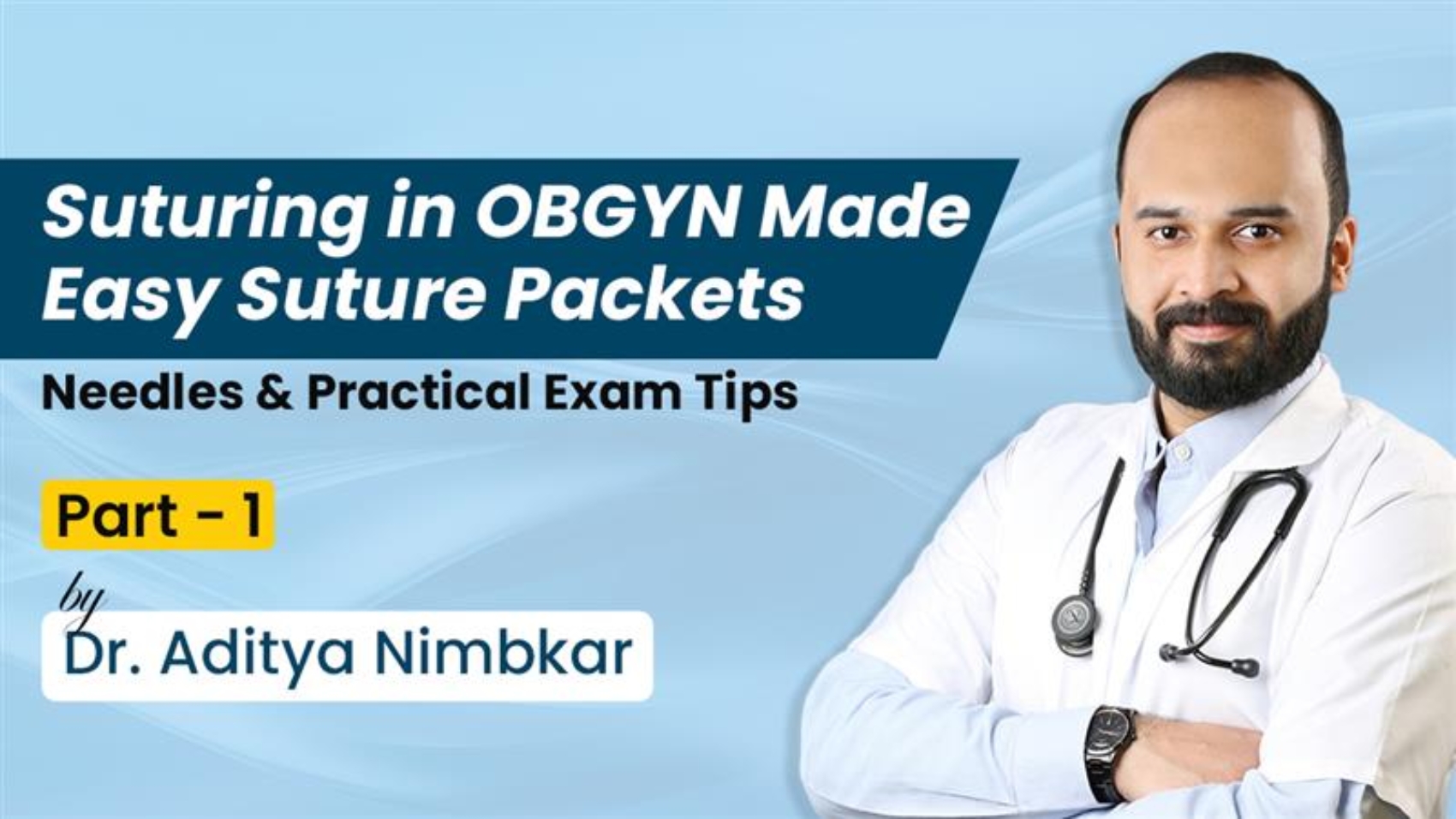
Suturing in OBGYN Made Easy Suture Packets, Needles & Practical Exam Tips – Part 1 By Dr. Aditya Nimbkar

0
0

Estimated reading time: 5 minutes

Suturing is one of the most fundamental yet most confusing topics for OBGYN residents—especially during exams and early OT postings. Different packets, unfamiliar markings, multiple brands, and endless viva questions often make sutures feel more complicated than they really are. 

In this first part of a two-part series, Dr. Aditya Nimbkar simplifies suturing in OBGYN by breaking down commonly used suture materials, how to read suture packets, and how to answer suturing questions confidently in exams. 

Why Sutures Matter More Than You Think?

If there is one skill that stays with you throughout residency and beyond, it is suturing. From LSCS and episiotomy repair to hysterectomies and laparoscopic vault closure, the right suture makes a significant difference to healing, infection rates, and patient comfort. 

This session focuses on the most frequently used sutures in obstetrics and gynecology, starting with Vicryl and moving on to silk and Mersilene. 

Understanding a Suture Packet: What to Read First 

Before using any suture, always understand what the packet is telling you. Every suture packet contains critical information: 

1. Suture Size (US Gauge System) 
  • 1, 2, 3 → thicker sutures 
  • 1-0, 2-0, 3-0, 4-0 → progressively thinner sutures 

Think of 1-0 as the center point: 

  • Numbers without zeros → thicker 
  • Numbers with more zeros → thinner 
2. Suture Length 
  • Usually mentioned in centimeters 
  • Common lengths: 70 cm or 90 cm 
3. Needle Details 

Each packet also mentions: 

  • Needle length (e.g., 20 mm or 30 mm) 
  • Needle shape (half circle, 3/8 circle) 
  • Needle type 
  • Round body (used for uterus, muscle) 
  • Tapered tip 
4. Absorbable vs Non-Absorbable 

Clearly mentioned on the packet and extremely important for exams. 

The Three Golden Points to Describe Any Suture in Exams 

Whenever you are shown a suture in viva, always describe it using three fixed parameters: 

  1. Natural or Synthetic 
  1. Absorbable or Non-absorbable 
  1. Monofilament or Multifilament (Braided) 

If you remember just this framework, your suturing viva will almost always go well. 

Vicryl (Polyglactin 910): The Gold Standard 

Vicryl is one of the most commonly used sutures in OBGYN. 

Key Features 
  • Synthetic 
  • Absorbable (Delayed absorbable) 
  • Multifilament (Braided) 
Strength & Absorption 
  • Loses 50% strength in ~3 weeks 
  • Loses 75% strength by 5–6 weeks 
  • Completely absorbed in 50–70 days 
  • Absorbed by hydrolysis 
Advantages 
  • Excellent tensile strength 
  • Easy handling 
  • Ideal for: 
  • Uterine closure after LSCS 
  • Episiotomy repair 
  • Vaginal tears 
  • Abdominal & vaginal hysterectomy 
  • Laparoscopic vault suturing 
  • Multilayer myomectomy closure 
Disadvantage: Wicking 

Because Vicryl is braided, it allows capillary spread of fluids and bacteria, a phenomenon known as wicking. This makes it less suitable in infected fields and unsuitable for skin closure. 

Rating: 9/10 

A reliable, versatile, and time-tested suture. 

Vicryl Plus: Added Infection Protection 

Vicryl Plus is essentially Vicryl with a key upgrade. 

Vicryl Rapid: Designed for Fast Healing Areas 

Episiotomy wounds heal quickly, so prolonged suture presence causes discomfort and dyspareunia. Vicryl Rapid was developed to address this. 

Key Features 
  • Gamma-irradiated 
  • 50% strength lost in 5–6 days 
  • Completely absorbed in 2–3 weeks 
Ideal Use 
  • Episiotomy repair 
  • Vaginal lacerations 
Not Suitable For 
  • Uterine suturing 
Rating: 8/10 

Perfect for perineal repairs, limited elsewhere. 

Silk (Mersilk): A Suture of the Past 
Characteristics 
  • Natural 
  • Multifilament 
  • Practically non-absorbable 
  • Loses 50% strength after 1–1.5 years 
Why It’s Rarely Used Now 
  • Stays in tissue for years 
  • High risk of: 
  • Foreign body granuloma 
  • Chronic inflammation 
Rating: 5/10 

Given mostly out of respect for its historical importance. 

Mersilene Tape: Still Very Relevant 

Mersilene tape is entirely different from silk, despite the similar name. 

Key Features 
  • Synthetic 
  • Permanent 
  • Multifilament 
  • Made of polyester 
  • Silicone-coated for smooth passage 
Uses 
  • Cervical cerclage (Shirodkar, abdominal cerclage) 
  • Sling surgeries 
  • Cervicopexy 
  • Sacrocolpopexy 
  • Prolapse surgery in young women 
Disadvantages 
  • Difficult handling 
  • Risk of erosion if exposed near skin or vaginal mucosa 
Rating: 7/10 

Essential in modern gynecologic surgery despite handling challenges. 

What’s Coming in Part 2? 

So, In the next session we will cover: 

  • Staplers 
  • Prolene 
  • Ethilon 
  • Catgut 
  • Linen 
  • Monocryl 
  • Barbed sutures (Stratafix) 
Final Takeaway 

Understanding sutures is not about memorizing brands—it’s about knowing why, where, and how to use them. Once you learn how to read a suture packet and apply the three-point description rule, both exams and OT work become far easier. 

Stay tuned for Part 2 of this comprehensive suturing series. 

Share

obstetrics and gynecology residents

Managing Common OBS/GYN Emergencies: A Guide for the Obstetrics and Gynecology Resident

0
1

Estimated reading time: 4 minutes

Mastering over the management of common OBS/GYN emergencies is important for those embarking on their obstetrics and gynecology residency journey. This guide seeks to offer practical advice to obstetrics/gynecology residents on how to diagnose and manage frequent OBS/GYN emergencies by tapping into established obstetric emergencies guidelines and best practices within residency training.

Why Preparedness in OBS/GYN Residency Programs is Important?

Obstetrics Gynecology Residency Training Programs of future specialists should provide training in various scenarios including emergency conditions. In your obstetrics and gynecology residency program, you will encounter several OBS/GYN emergencies which must be addressed promptly and with decisiveness.

Apparent Obstetric Emergencies Presenting in Labor
  1. Postpartum Hemorrhage (PPH)
    • Definition: Profuse bleeding following delivery
    • Management: Massage of uterus, uterotonics, and blood transfusion if necessary
  1. Shoulder Dystocia
    • Signs & Symptoms: Failure to expose the shoulders after delivery through the vagina
    • Management: McRoberts maneuver, suprapubic pressure, maneuvers of internal rotation
  1. Eclampsia
    • Signs & Symptoms: Convulsion in a woman with preeclampsia
    • Management: Magnesium sulfate, blood pressure control, preparation for delivery
Gynecological Emergency
  1. Ectopic Pregnancy
    1. Acceptance: Pain in the lower abdomen, bleeding through the vagina, confirmed positive pregnancy test.
    2. Management: Surgery or medical treatment with methotrexate
  1. Ovarian Torsion
    1. Acceptance: Onset of pain in the lower abdomen with nausea and vomiting.
    2. Management: Emergency surgery to untwist
  1. Pelvic Inflammatory Disease (PID)
    1. Acceptance: Pain in the lower abdomen; generalized ache, fever and abnormal vaginal discharge.
    2. Management: Broad-spectrum antibiotics, pain management
Conceptual OBG Approach to Emergency Management

Conceptual OBG thinks that the management of obstetric emergencies needs a holistic approach. Our platform offers all obstetrics and gynecology residents, during discussion on:

  1. Simulation-based training: Practice handling obstetric and gynecologic emergencies in a controlled environment.
  1. Case-based learning: Review real-world cases that can help you hone your decision-making.
  1. Current protocols: Learn more about the most recent obstetric emergencies guidelines and best practices.
OBS/GYN Residency Program Tips
  1. Stay calm: Emergencies are a very tense situation, yet composure plays a significant role in maintaining clear thinking and effective management.
  1. Communicate clearly: Make sure everyone in the team knows what to do and what the course of action is.
  1. Know your resources: Be on the lookout for the equipment and personnel available in your facility.
  1. Practice regularly: Attend drills and simulation activities to hone your skills.
  1. Debrief after emergencies: Discuss with your team and obstetric-gynecology faculty what went right and how things can be improved.
Your Role of Conceptual OBG in Your Residency Training

Conceptual OBG is committed to your service, focusing on assisting OBS/GYN residency programs with state-of-the-art resources and training materials. They can all be accessed from our portal:

  • Complete modules on every significant OBS/GYN topics
  • Interactive case studies on obstetric emergencies during labour
  • Simulation modules for practicing emergency management by simulation
  • updates on the latest research and guidelines

The integration of Conceptual OBG into your residency training would best make one feel more confident when it comes to the handling of the wide variety of OBS/GYN emergencies, so you’re all set for further success in the obstetrics and gynecology field.

Conclusion

Common OBS/GYN emergencies would never be complete without some incorporation of these essentials into the education of an obstetrics gynecology resident. You can be well-prepared, continue learning, and utilize resources such as Conceptual OBG about handling any emergent situation that may arrive your way.

Finally, are you ready for that push to take your obstetrics and gynecology residency to a whole new level? In order to unlock our plentiful library of resources, interactive modules, and expert-led webinars, register with Conceptual OBG today. No more surviving your residency, as Conceptual OBG guides and helps you thrive in it. Visit our website or talk to us about how we can help you develop into an exceptional OBS/GYN specialist.

Share